For research and educational purposes only. Not medical advice.
Retatrutide reconstitution and dosing: a practical guide
Reconstitution is two steps: mix the powder with bacteriostatic water to set a mg-per-mL concentration, then draw the right volume for your dose…
For research and educational purposes only. Not medical advice.
Category: GLP-1. 7 min read. By pepSmart Editorial. .
Key takeaways
- Reconstitution is two steps: mix the dry powder with bacteriostatic water to set a concentration, then draw the right volume for your dose. The first step is simple multiplication; the second step is where the real mistakes happen.
- Bacteriostatic water (sterile water with 0.9 percent benzyl alcohol) is the standard diluent for a multi-dose vial because the preservative limits germ growth between draws .
- On a U-100 insulin syringe, 100 units equals 1 mL, so the unit marks measure volume, not milligrams. Drawing to the 20 mark is 0.2 mL, not 20 mg. Reading units as milligrams is the dosing error the FDA has repeatedly flagged with do-it-yourself GLP-1 drugs .
- Trial dosing climbs slowly: retatrutide was started low and stepped up about every four weeks to reach 8 mg and 12 mg, because tolerability tracks how fast you escalate as much as the final dose .
- It is injected once a week because the molecule has a long half-life of roughly six days . And it is still investigational, so there is no approved pen, no official concentration, and no label to copy.
Two steps, and only one of them is dangerous
Approved GLP-1 drugs like semaglutide and tirzepatide hide all of this inside a pre-filled pen, so the user never touches concentrations or units. Retatrutide has no approved product, so people who obtain it as a research powder are doing the manufacturer's job by hand. That is worth saying plainly up front, because the steps below describe how the math works, not a recommendation to self-administer an investigational drug.
How reconstitution actually works
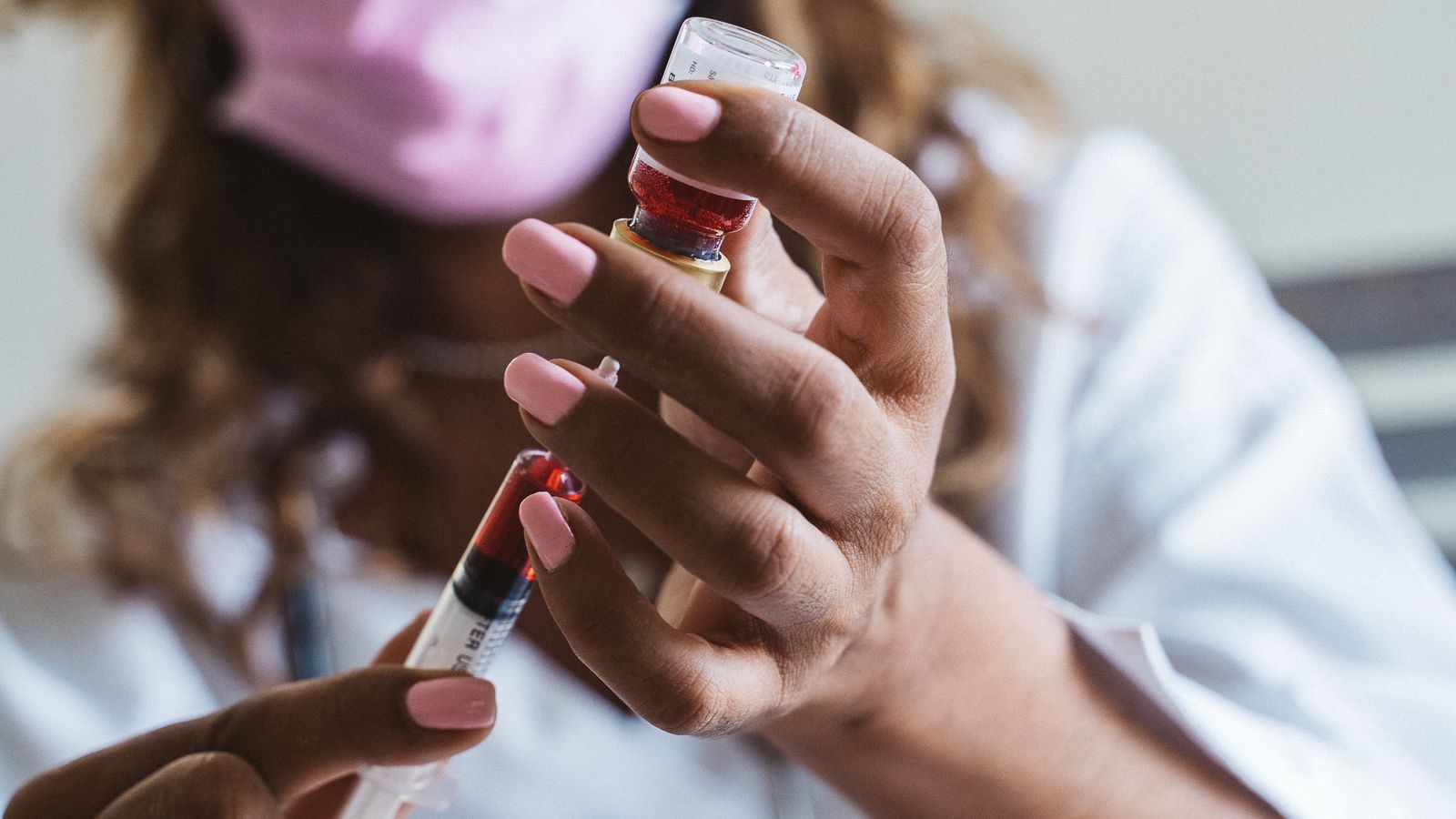
Retatrutide arrives freeze-dried (lyophilized) as a small puck or film of powder in a sealed vial. Reconstitution just means dissolving it in liquid so it can be drawn into a syringe. The liquid of record is bacteriostatic water, which is sterile water with 0.9 percent benzyl alcohol added as a preservative. That preservative is the reason it suits a vial you will draw from over several weeks: it limits microbial growth between punctures, which plain sterile water (single-use, no preservative) does not .
- Add the water slowly, aiming the stream down the inside wall of the vial rather than blasting it onto the powder.
- Swirl gently or let it sit to dissolve. Do not shake hard; peptides are fragile and aggressive shaking can damage them.
- Once mixed, it is a liquid that needs refrigeration, and reconstituted multi-dose vials are generally treated as good for about 28 to 30 days.
- Write the date and the concentration on the vial. The concentration is the number every later dose depends on.
Turning a dose into syringe units: a worked example
Here is the conversion that trips people up, done slowly. Say a vial holds 10 mg of retatrutide and you add 1 mL of bacteriostatic water. That is 10 mg per mL. To draw a 2 mg dose you need 0.2 mL. On a U-100 insulin syringe, 100 units equals 1 mL, so 0.2 mL is 20 units. The number 20 there is a volume reading, not a milligram amount.
| Target dose | Volume to draw | U-100 syringe reading |
|---|---|---|
| 2 mg | 0.2 mL | 20 units |
| 4 mg | 0.4 mL | 40 units |
| 8 mg | 0.8 mL | 80 units |
| 12 mg | 1.2 mL | 120 units (over a 1 mL syringe) |
Illustrative arithmetic only (concentration = mg in vial / mL of water; units = mL x 100 on a U-100 syringe). Retatrutide is investigational and has no approved concentration or labeled dose.
Notice the last row. At 10 mg/mL the top of the ladder is 1.2 mL, which is more than a standard 1 mL (100-unit) syringe holds, so the 12 mg step would need a second draw or a more dilute mix planned from the start. That is exactly the kind of whole-ladder planning a reconstitution calculator is built for, and the mg-to-units conversion tool shows the volume-and-units step instead of leaving it to mental math.
The dose ladder: start low, climb slowly
The doses people quote for retatrutide, 4 mg, 8 mg, and 12 mg weekly, are the targets, not the starting point. In the Phase 2 obesity trial, the drug was started at a low dose and stepped up roughly every four weeks until participants reached their assigned target, a pattern usually summarized as 2, then 4, then 8, then 12 mg .
The four-week spacing is not padding. Gut side effects (nausea, vomiting, diarrhea, constipation) track the rate of escalation as much as the absolute dose, so climbing faster mostly buys you more nausea, not faster results. The slow start at a lower dose is the single biggest lever for tolerability. For the full picture of what those side effects look like, that is its own piece on retatrutide side effects.
Why it is a once-a-week shot
Retatrutide is engineered to stick around. It carries a fatty-acid chain that lets it bind to albumin in the blood, which stretches its half-life to roughly six days . A half-life that long means one injection keeps a fairly steady level all week, which is why the trials dosed it once weekly rather than daily.
The practical version: pick a day, keep it consistent, and do not try to make up for a slow week by stacking doses closer together. With a six-day half-life the drug from last week is still substantially on board when the next dose lands.
The mistake that actually sends people to the hospital
If you remember one thing, remember this: units are volume, milligrams are dose, and confusing them is how overdoses happen. The FDA has issued specific alerts about dosing errors with do-it-yourself and compounded GLP-1 products, including five-fold and ten-fold overdoses, hospitalizations, and worse, often traced to someone drawing to a unit mark as if it were milligrams, or assuming the wrong vial concentration .
A calculator gets the arithmetic right, but it cannot see your vial. It assumes the label is accurate, that the concentration has not drifted in storage, and that you read the syringe correctly. Research-grade vials carry no guarantee of identity, purity, or the stated milligram amount, so the number you type in may not be the number in the glass. The deeper walk-through of those failure modes lives in reconstitution math for GLP-1 self-titration, and the difference between units, milligrams, and micrograms has its own explainer.
The honest read
The reconstitution math is genuinely simple: water plus powder sets a concentration, and the concentration tells you the volume to draw. The risk is not the algebra. It is the unit-conversion step, a vial whose real contents you cannot verify, and a dose ladder that rewards patience and punishes rushing.
And the largest caveat sits above all of it: retatrutide is still investigational. There is no approved pen, no official concentration, and no prescribing label to copy, so everything above is a description of how the math works rather than a dosing protocol. Decisions about taking it, and especially about combining it with insulin or other diabetes medicines, belong with a clinician who can see your full picture.
For research and educational purposes only. Not medical advice.
pepSmart has not commissioned independent clinical review of this article.
More on how we write and source these pieces: Editorial process and contributor disclosure and Sourcing posture.
Spot an error? Email corrections via /about.
Sources: 4 entries, primary canon plus one peer-reviewed review acknowledged inline (the retatrutide Phase 2 obesity trial, a 2025 retatrutide review for the pharmacokinetics, the FDA bacteriostatic water labeling, and the FDA alert on compounded GLP-1 dosing errors). Last reviewed 2026-06-30.
Related tools
- Tirzepatide dose calculator - Run tirzepatide-focused vial draw math.
- GLP-1 conversion calculator - Convert a GLP-1 mg dose to U-100 units and ml.
- GLP-1 ramp planner - Preview a linear educational dose-step table.
- Peptide half-life calculator - Estimate single-dose decay from cited half-life constants.
- PK simulator overview - Public overview of the Pro pharmacokinetic simulator.
- Semaglutide dose calculator - Run semaglutide-focused vial draw math.
References
- [1] Jastreboff AM, et al. Triple-Hormone-Receptor Agonist Retatrutide for Obesity, A Phase 2 Trial. N Engl J Med 2023 (PMID 37366315): once-weekly subcutaneous retatrutide given with stepwise dose escalation to 4, 8, and 12 mg targets (PubMed (New England Journal of Medicine))
- [2] Retatrutide: A Game Changer in Obesity Pharmacotherapy (2025 review, PMC12190491): an albumin-binding fatty-acid moiety gives a long half-life supporting once-weekly subcutaneous dosing (NIH / NCBI PMC (peer-reviewed review))
- [3] DailyMed: bacteriostatic water for injection labeling (sterile water with 0.9 percent benzyl alcohol as a preservative; intended for multi-dose use) (U.S. FDA via DailyMed)
- [4] FDA alerts health care providers, compounders, and patients of dosing errors associated with compounded injectable semaglutide products (units-versus-milligrams misreads, wrong concentration, 5-fold and 10-fold overdoses) (U.S. FDA)